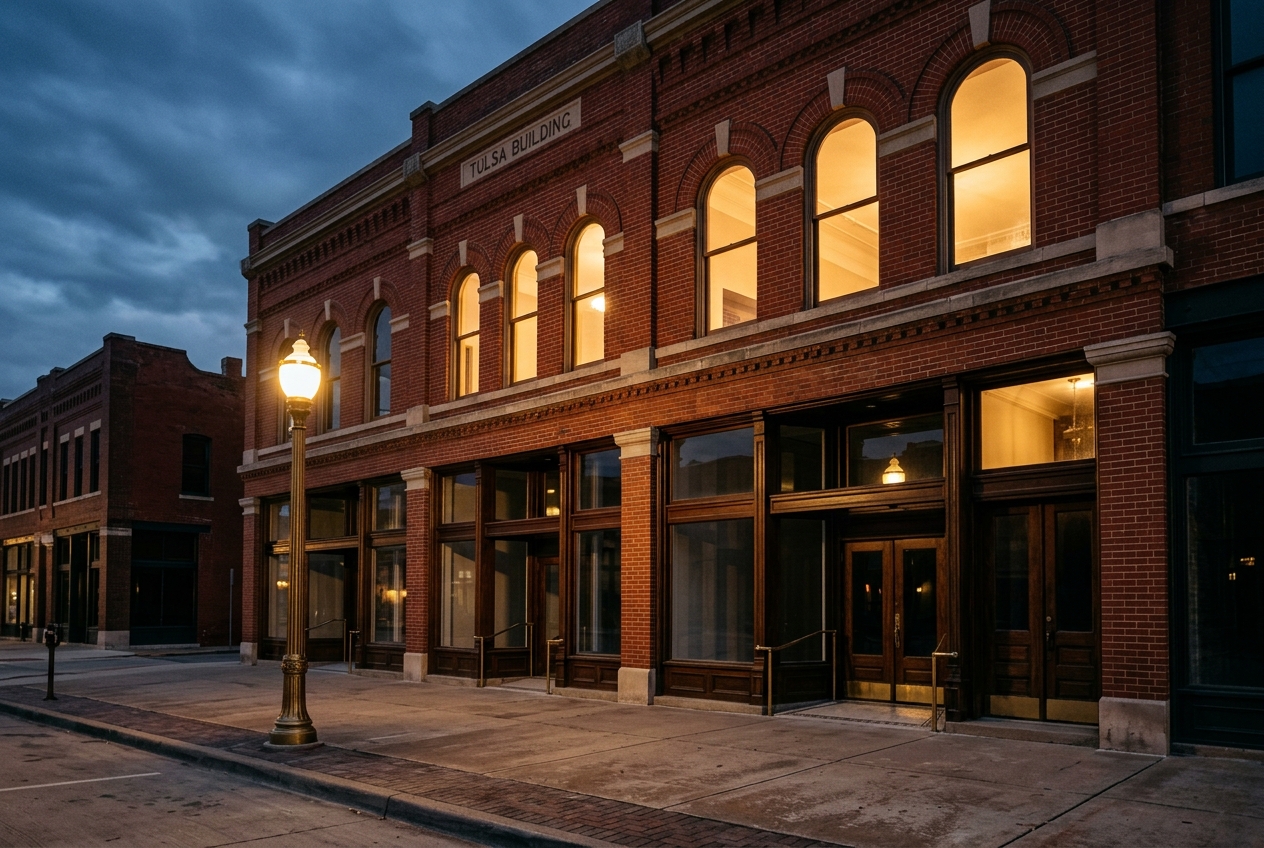
Oklahoma · Greenwood & the Black Wall Street corridor
Tulsa
Thirty-five blocks of Black wealth, destroyed in eighteen hours, and rebuilt without a dollar of insurance money.
Why this city
By 1921 Greenwood held some three hundred Black-owned businesses across roughly thirty-five blocks — hotels, theatres, two newspapers, doctors, lawyers, its own economy circulating dollars inside the district. On the 31st of May and the 1st of June that year, a white mob, deputised and in places supported from the air, burned it. Hundreds are believed to have been killed; thousands were left homeless; not one insurance claim was paid.
Greenwood rebuilt itself anyway, largely by 1925 and largely without outside capital. Urban renewal and a highway did in the 1960s and 70s what the mob had not managed permanently. What survives is one block of original storefronts, the churches, the archive, and a set of survivors and descendants who have spent a century asking a very specific question about restitution.
Oklahoma also holds the other half of this story: the Freedmen of the Five Tribes, people of African descent enslaved by Cherokee, Choctaw, Chickasaw, Creek and Seminole nations, whose citizenship and land claims remain contested in tribal courts today. If you have two days, Tahlequah is ninety minutes east.
Museums & historic sites
Greenwood Rising
The history centre at Greenwood and Archer. Start here; the massacre sequence is unflinching and correctly framed.
The Greenwood Cultural Center
Community-run, with the survivor photographs and the district's own archive. Ask what is not on the wall.
Vernon AME Church
The basement survived the burning and the congregation never left. Services are open.
Mabel B. Little Heritage House
A 1920s Greenwood home, preserved as the district's domestic record.
John Hope Franklin Reconciliation Park
For the hour after Greenwood Rising, when you will not want to talk.
Mounds & ancient Indigenous ground
Earthworks, shell rings and mound complexes within reach of the city — most of them older than anything else you will see on this trip. Where a site sits on sovereign or restricted land, enter with a tribal or preserve guide, and never climb a mound.
Spiro Mounds Archaeological Center
Two hours south-east: the only Mississippian site in Oklahoma open to the public, and the source of one of the richest assemblages ever excavated in North America — much of it looted in the 1930s and still being repatriated.
Cherokee Nation, Tahlequah
Ninety minutes east: the capital, the Cherokee National History Museum, and the Supreme Court building of 1844. Also where Freedmen citizenship is still argued.
Muscogee (Creek) Nation, Okmulgee
An hour south: the Council House Museum, and the other end of the removal that emptied Ocmulgee in Georgia.
Osage Nation, Pawhuska
An hour north-west, in the county where the 1920s murders took place. The Osage Nation Museum is the oldest tribally owned museum in the country.
Where to stay
A Black-owned stay in or near the Greenwood district
Booked through the Circle's desk. Where a city has no Black-owned house at this standard, we say so and place you in the best independent room instead.
A Downtown Tulsa base within walking distance of Greenwood and Archer
Independently held; the district is best entered on foot and early.
The table
Black-owned kitchens on the Greenwood corridor
The current generation of restaurateurs rebuilding the commercial block. Eat here rather than downtown.
A soul food room in North Tulsa
Family-run, lunch service, and the fastest way to understand the neighbourhood now.
Tours & walks
A Greenwood walking tour led by a descendant
Thirty-five blocks, on foot, with the plat maps. The single most important two hours in Tulsa.
A Black Wall Street business tour
The economics: what circulated, what was insured, what was never paid.
A Freedmen of the Five Tribes day toward Tahlequah
Ninety minutes east, with a guide from the Freedmen community. Arranged in advance only.
Members have this city's stays, tables and guides booked for them, with introductions where protocol allows. Everyone else is welcome to use the guide exactly as written.
All city guidesNext step
Behind the closed gate.
Our community-governed journeys and the Sovereign Florida Circuit go where a guidebook cannot take you.