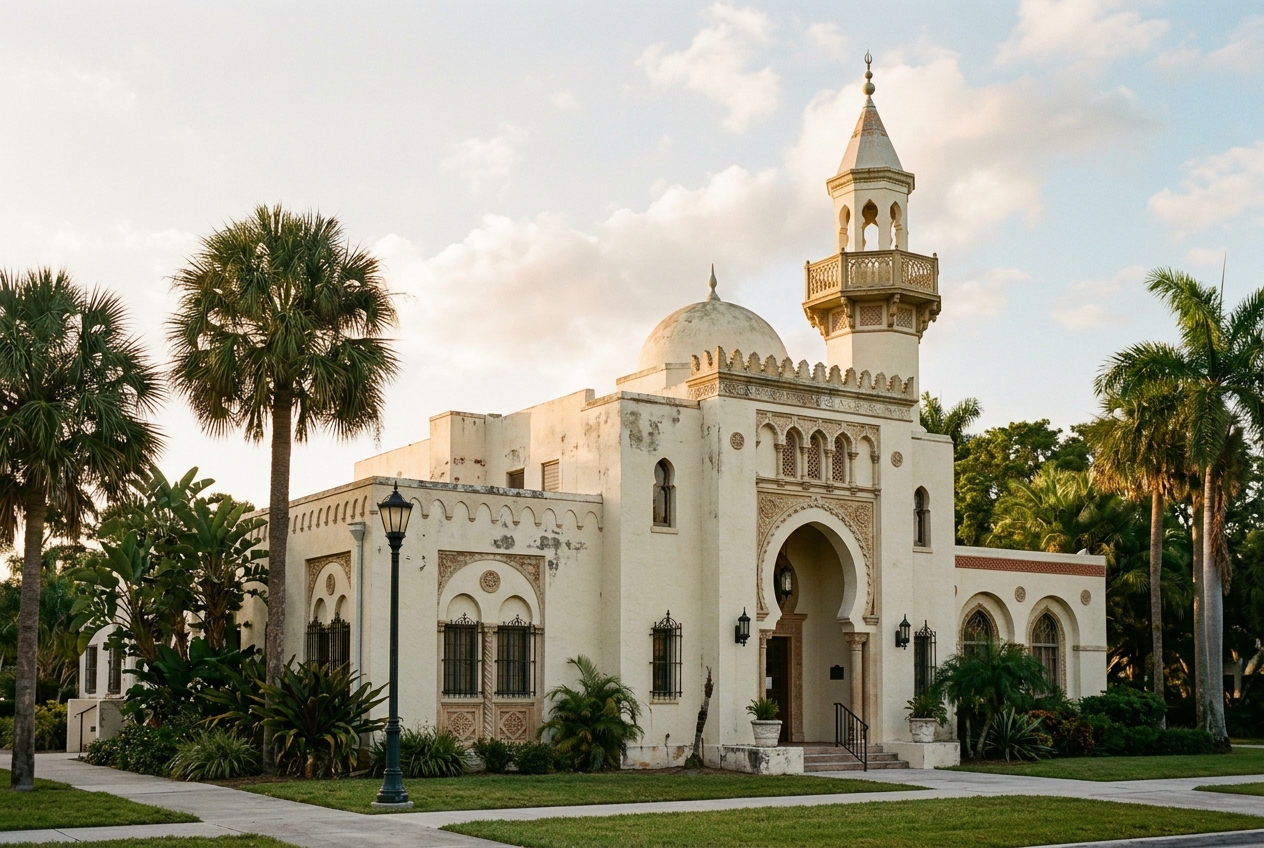
Florida · The Moorish Revival district & Historic City Hall
Opa-locka, Miami
The largest collection of Moorish Revival architecture in the Western Hemisphere is in a Black city in North Miami-Dade.
Why this city
In 1926 the aviator Glenn Curtiss laid out a city on the theme of One Thousand and One Nights: domes, minarets, keyhole arches, and streets named Sabur Lane, Sesame Street, and Ali Baba Avenue. The hurricane of that September and the collapse that followed ended the boom, but the buildings survived — the largest concentration of Moorish Revival architecture in the Western Hemisphere.
The city's population became predominantly Black through the 1960s and 70s, and Opa-locka has since carried both the architecture and the hard end of South Florida's disinvestment: an aviation legacy, an art and archive community, real economic pressure, and a historic core of national significance.
Come for the architecture and stay for what is being done with it. Ask before you photograph a residential street; this is a place people live, not a set.
Museums & historic sites
Opa-locka Historic City Hall
The 1926 Curtiss centrepiece, domes and all. Restoration is ongoing; the exterior alone justifies the drive.
The Moorish Revival district
Twenty-odd surviving structures on and around Ali Baba Avenue and Sharazad Boulevard, on the National Register.
Ten North Group / ARTSail & the arts campus
The community development organisation restoring buildings and running gallery and studio programmes.
Opa-locka Executive Airport
Curtiss's original field, and part of the Tuskegee-era training landscape in South Florida.
Mounds & ancient Indigenous ground
Earthworks, shell rings and mound complexes within reach of the city — most of them older than anything else you will see on this trip. Where a site sits on sovereign or restricted land, enter with a tribal or preserve guide, and never climb a mound.
Snake Warriors Island, Miramar
Thirty minutes south-west: a natural area named for the Seminole community that held this ground during the Seminole Wars, with wetland restored to its pre-drainage state.
Ah-Tah-Thi-Ki Museum, Big Cypress
Ninety minutes west on the Seminole Tribe of Florida's reservation — the tribe's own museum, boardwalk and living village. The definitive account, told by the nation itself.
The Everglades tree islands
The hammocks north-west of the city are the ground the Seminole and Miccosukee were never removed from. Enter with a tribal guide or not at all.
Where to stay
A Black-owned stay in North Miami-Dade
Booked through the Circle's desk. Where a city has no Black-owned house at this standard, we say so and place you in the best independent room instead.
A base in Miami Beach or downtown with a driver
Most members visit Opa-locka as a half-day from a downtown base.
The table
Caribbean and Southern kitchens in North Miami-Dade
Jamaican, Haitian and soul food within a few blocks. Lunch, not dinner.
A Black-owned bakery or coffee house on the arts campus
Where the restoration crowd actually eats.
Tours & walks
An architectural walk of the Moorish Revival core
With a local preservationist — the only way the district makes sense.
A North Miami-Dade Black heritage drive
Opa-locka, Liberty City and Brownsville in one afternoon, with a resident guide.
Members have this city's stays, tables and guides booked for them, with introductions where protocol allows. Everyone else is welcome to use the guide exactly as written.
All city guidesNext step
Behind the closed gate.
Our community-governed journeys and the Sovereign Florida Circuit go where a guidebook cannot take you.