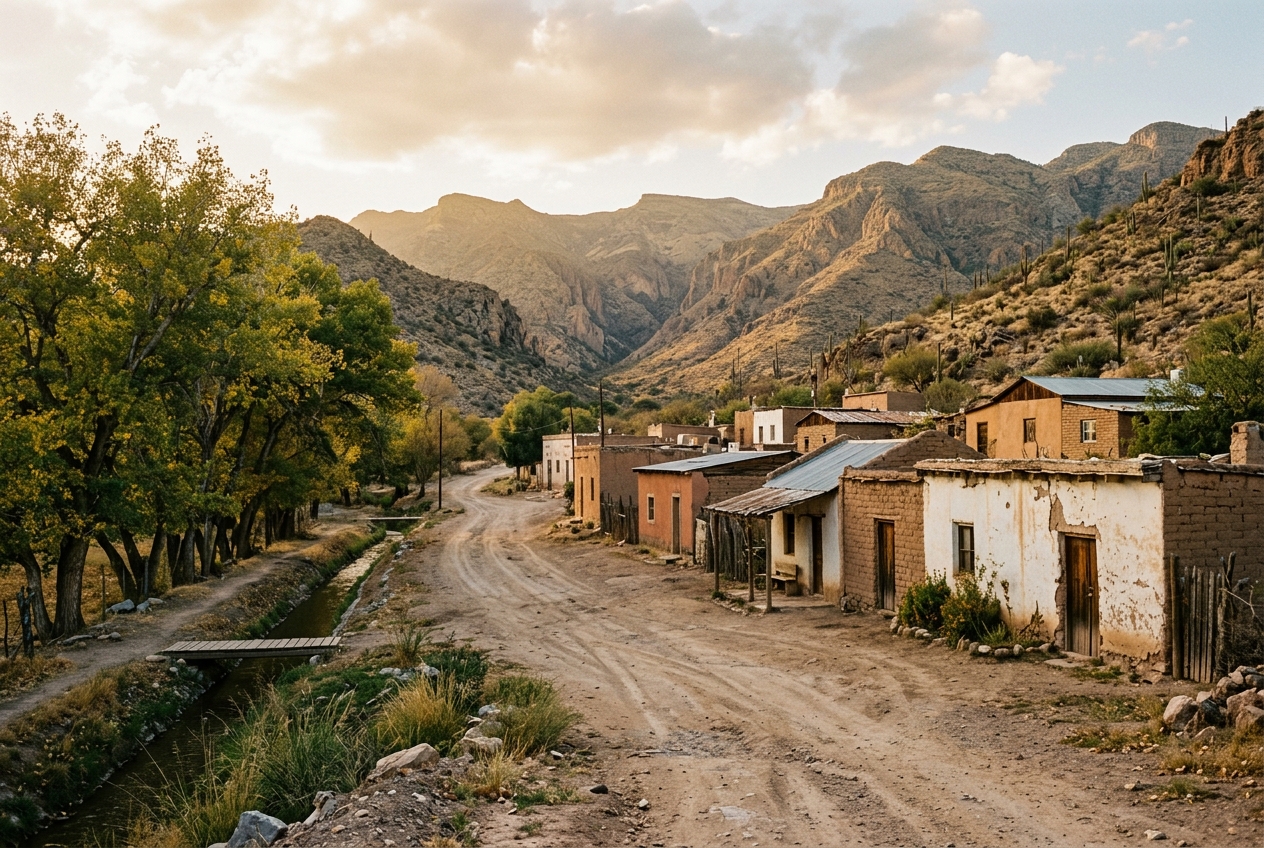
Coahuila, Mexico · El Nacimiento de los Negros & Melchor Múzquiz
El Nacimiento & Múzquiz
The Underground Railroad also ran south. This is where it ended.
Why this city
Most Americans are taught that freedom seekers ran north. Thousands ran south. Mexico abolished slavery in 1829 and refused to return the people who reached it, which made the Rio Grande a freedom line for three decades before the Civil War.
In 1850 a party of Black Seminoles and Seminoles crossed at Eagle Pass under John Horse and the Seminole leader Coacoochee — Wild Cat — and were granted land at El Nacimiento de los Negros in exchange for defending the northern frontier against raids. Their descendants, the Mascogos, are still on that grant, still Catholic, still cooking the same three dishes on the nineteenth of June, and still holding fragments of Afro-Seminole Creole. Some of the family returned to Texas in 1870 to serve as the Seminole Negro Indian Scouts; four of them won the Medal of Honor, and they are buried at Brackettville.
This is not a developed destination and should not be treated as one. El Nacimiento is a working ejido roughly forty minutes from Múzquiz on unpaved road. There is no hotel in the village. Visitors are received, generously, by a community that has decided to receive them — which means you arrange it through the community's own committee, you arrive on the nineteenth rather than whenever suits you, and you ask before you photograph anyone.
Nearby, the Kickapoo community at El Nacimiento de los Kickapoos share the same valley and the same nineteenth-century agreement. The two nations' histories are separate and adjacent, and neither should be collapsed into the other.
Museums & historic sites
The Mascogo community museum, El Nacimiento
Small, community-run, and the only place this history is told by the people holding it. Contributions go to the committee, not a gate.
The Juneteenth observance, 19 June
Mass, the pit, and the songs. Attend as an invited guest through the community committee — never as a drop-in.
The El Nacimiento cemetery
Where the 1850 generation is buried. Enter quietly and with a community member.
Museo de Múzquiz
In town, forty minutes away: regional history including the Mascogo and Kickapoo agreements.
Seminole Negro Indian Scouts Cemetery, Brackettville, Texas
Across the border: four Medal of Honor recipients and the same family line. The two halves of one story.
Mounds & ancient Indigenous ground
Earthworks, shell rings and mound complexes within reach of the city — most of them older than anything else you will see on this trip. Where a site sits on sovereign or restricted land, enter with a tribal or preserve guide, and never climb a mound.
El Nacimiento de los Kickapoos
The Kickapoo community in the same valley, holding land under a parallel nineteenth-century agreement. Visit only by invitation; ceremony is closed.
Cueva de la Candelaria, Coahuila
A Desert-culture burial cave whose remarkable fibre textiles are held in Mexican national collections. The cave itself is protected.
Sierra de Santa Rosa rock art
Painted and incised panels across the Coahuila sierra, largely unmarked and reached only with a local guide.
Coahuilteco and Tobosos homeland
The northern desert nations who held this ground before either community arrived, and who are largely absent from the record by design.
Where to stay
An independent hotel in Melchor Múzquiz
There is no lodging in El Nacimiento. Múzquiz is the base — forty minutes out on unpaved road, and the Circle's desk books it.
A Piedras Negras or Eagle Pass night either side
Most members break the border crossing with one night on each side.
The table
Mascogo cooking on the nineteenth
Asado de puerco, tetapún baked in ashes, capirotada. Cooked by households, not restaurants. Eat what is offered.
Northern Coahuila tables in Múzquiz
Cabrito, machacado, flour tortillas. Family-run, cash only, lunch is the main meal.
Tours & walks
A community-arranged visit to El Nacimiento
Through the Mascogo committee, in advance, in Spanish. The Circle handles the correspondence and the protocol brief.
A cross-border Black Seminole route
Eagle Pass, Brackettville and El Nacimiento in one loop, with a bilingual guide from the family line.
A Múzquiz and sierra day
The regional museum, the coal-country history, and the road into the valley.
Members have this city's stays, tables and guides booked for them, with introductions where protocol allows. Everyone else is welcome to use the guide exactly as written.
All city guidesNext step
Behind the closed gate.
Our community-governed journeys and the Sovereign Florida Circuit go where a guidebook cannot take you.